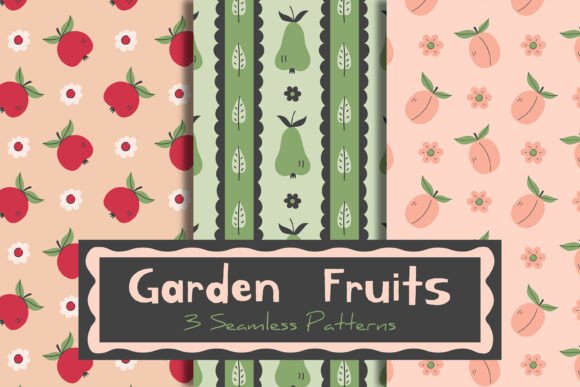
Garden Fruits Seamless Patterns Papers
Bringing a sweet garden charm into your creative projects often starts with the right foundational assets. If you are looking to infuse your designs with a touch of freshness and bloom, Garden Fruits Seamless Patterns Papers offers a delightful solution. This collection features three playful, hand-drawn seamless designs that highlight apple, pear, peach, flowers, leaves, and botanical elements. Created in a minimal, simple, flat, kawaii, and whimsical style, these patterns bring soft pastel tones and childish, fun, cottagecore vibes to any project.
However, simply downloading a pattern pack is only the first step. Many creators, from hobbyists to professional print-on-demand sellers, overlook critical details when selecting and applying digital backgrounds. A mismatched file format, incorrect resolution settings, or poor understanding of seamless tiling can ruin an otherwise beautiful design. This guide helps you navigate those pitfalls, ensuring that your use of these vector-style illustrations results in high-quality, professional-looking outputs.
Understanding the Asset: What You Are Actually Getting
Before diving into application, it is vital to understand the technical specifications included in this zip file. The package contains 3 JPG files and 3 EPS files, all sized at 3600 x 3600 pixels (12” x 12”). These images are high-resolution at 300 dpi and are set in the RGB color space.
Why does this matter? Many beginners assume that all digital papers are created equal. They do not realize that RGB is designed for screens, while CMYK is required for physical printing. If you plan to sell physical products like greeting cards, fabric prints, or wall art, using RGB files directly can lead to significant color shifts—where vibrant pastels appear dull or muddy once printed. Always convert your RGB JPGs or EPS vectors to CMYK before sending them to a printer. The EPS files, being vector-based, offer superior scalability without loss of quality, making them ideal for large-format prints or detailed cropping.
Common Mistakes When Using Seamless Patterns
Seamless patterns are powerful tools, but they require specific handling to avoid visible seams or awkward repetitions. Here are the most common errors designers make when working with sets like Garden Fruits Seamless Patterns Papers, and how to correct them.
Ignoring the Tile Edge Alignment
A seamless pattern works by repeating infinitely. However, if you place the image incorrectly in your software, the edges will not match, creating a jarring grid effect. This is particularly noticeable with complex botanical elements like leaves and stems that cross the boundary of the tile.
- The Mistake: Dragging the pattern into a canvas without using the "Pattern Fill" or "Clipping Mask" tools, leading to misaligned edges.
- The Fix: Use your design software’s built-in pattern creation tool. In programs like Adobe Illustrator or Photoshop, define the area as a pattern swatch. This ensures the software handles the tiling mathematically, guaranteeing a perfect repeat.
Overlooking Vector vs. Raster Limitations
This set includes both JPG (raster) and EPS (vector) formats. Choosing the wrong one for your specific task can compromise quality.
- The Mistake: Scaling up a JPG file to fit a large banner or packaging box. Because JPGs are pixel-based, enlarging them beyond their original 12x12 inch size at 300 dpi will result in pixelation and blurriness.
- The Fix: For any project requiring scaling beyond the original dimensions, always use the EPS files. Vectors allow you to resize the apple, pear, and peach motifs to any size while maintaining crisp, clean lines. Reserve the JPGs for web graphics, social media posts, or small-scale print items where the 3600x3600 resolution is sufficient.
Misjudging Color Context
The "soft pastel tones" mentioned in the product description are visually appealing on screen, but they may lack contrast against certain backgrounds. Pastel pinks, yellows, and greens can get lost on light-colored paper or white digital canvases.
- The Mistake: Placing light pastel patterns directly over white backgrounds without adjusting opacity or adding borders.
- The Fix: Experiment with layer styles. Try placing the pattern on a slightly darker cream or beige background to enhance visibility. Alternatively, add a subtle drop shadow or a solid border around your design element to separate it from the pattern, ensuring readability and visual hierarchy.
Strategic Applications for Different Creators
Once you have avoided these technical traps, you can leverage the versatility of these cute vector-style illustrations across various industries. The whimsical, nature-inspired aesthetic is broad enough for multiple niches.
For Print-on-Demand Sellers
If you are selling on platforms like Etsy or Redbubble, ensure your mockups accurately represent the product. Do not just slap the pattern onto a t-shirt mockup. Consider how the pattern interacts with the fabric texture. Use the EPS files to create custom placements rather than full-surface repeats, which can sometimes look too busy. Focus on niche applications like baby shower invitations, nursery decor, or spring-themed stationery where the cottagecore vibe resonates strongly.
For Digital Planners and Stationery Designers
The 12x12 inch size is standard for scrapbooking and digital planner backgrounds. However, be mindful of file size. High-resolution JPGs can slow down digital planning apps if used excessively. Compress your files appropriately for web delivery while maintaining legibility. Use the seamless nature of the patterns to create long-scrolling backgrounds for digital journals, ensuring the repetition feels natural and not intrusive.
For Branding and Social Media
Small business owners can use these patterns for brand consistency. Imagine a bakery using the peach and apple motifs for their Instagram story backgrounds or website headers. The key here is moderation. Use the pattern as a subtle backdrop behind text or logos. Ensure the text has enough contrast to remain readable. The kawaii style appeals heavily to younger demographics and those interested in lifestyle branding, so align your typography to match the playful tone.
Final Checklist Before You Start Designing
To ensure satisfaction with your Garden Fruits Seamless Patterns Papers purchase, run through this quick checklist:
- Verify File Integrity: Open the EPS and JPG files to ensure they are not corrupted and display correctly in your software.
- Check Color Mode: Decide early if your end product is digital (RGB) or print (CMYK). Convert accordingly to avoid color disappointment.
- Test the Seam: Create a small test tile to check for edge alignment issues before committing to a full-page design.
- Assess Scalability: Determine if you need the vector precision of the EPS files or if the raster JPGs suffice for your resolution needs.
- Review Licensing: Although not explicitly detailed here, always check the commercial usage rights. Most seamless pattern packs allow for end-product sales but prohibit reselling the raw digital files themselves. Ensure your intended use complies with these terms.
By approaching these assets with technical awareness and creative strategy, you can transform simple fruit and floral motifs into compelling, professional designs. Whether you are crafting a children’s book, designing party decor, or building a brand identity, the sweet garden charm of these patterns provides a versatile foundation for success.